Monday, November 22, 2010

Six biggest health dangers facing residents


Six biggest health dangers facing residents

... and what you need to do to stay clear of them

By
  • Bindu Suresh Rai
Published Sunday, November 21, 2010

With stressful lives giving way for more illnesses to knock on our doors. (SUPPLIED)

If you too have witnessed the increase in public health awareness campaigns in the UAE in the recent months, then it is simply because the government and health authorities are taking action at the alarming figures that are rising around us.

With stressful lives giving way for more illnesses to knock on our doors, Emirates 24|7 takes action by listing the top six killers in the country and how you can give yourself a health check to reduce your risk.

1. Heart disease

According to statistics released earlier this year by the Ministry of Health, over 25 per cent of deaths in the UAE are caused by cardiovascular disease and high cholesterol levels, which are a major cause of heart disease.

And it's not just the expat population that is at risk here. In a presentation on Preventive Health Measures and Public Health: The Role of Primary Care, Dr Cother Hajat, section head, public health programmes at the Health Authority Abu Dhabi, revealed that at least 71 per cent of Emiratis, averaging 35 years, have at least one risk factor. Meanwhile, eight per cent males and two per cent females are at high risk of developing cardiovascular diseases in the next 10 years.

Take action:  To minimise your risk, some lifestyle changes are important:

- Don't smoke, and no, cutting down does not count.

- Limit your intake of alcohol.

- Start weight control immediately.

- Exercise regularly, even at home if the gym is not possible.

- Control high blood pressure, diabetes and high cholesterol.

- Opt in for regular health checks, especially as you grow older.

- Meditate, or take up some breathing exercises

2. Diabetes

Over the last 10 years, the number of diabetes related deaths have increased by 45 per cent in the developing world, with the UAE in the forefront.

Recent figures from the International Diabetes Federation (IDF) suggest that 285 million people are living with diabetes, worldwide, with an alarming five GCC countries featuring in the top eight countries in terms of diabetes prevalence as a percentage of the population.

In the UAE, diabetes currently affects 18.7 per cent of the UAE adult population, the second highest prevalence worldwide after the Pacific Ocean island of Nauru.

Studies into the death rates indicate that diabetes is generally under-reported, particularly in the cases of older persons with multiple conditions such as heart disease and hypertension. Because of this, the toll of diabetes is believed to be much higher than officially reported.

 While Type 1 diabetes is something you can be made aware of earlier in line, many people first become aware of Type 2 diabetes only when they develop one of its serious and life-threatening complications such as heart disease, high blood pressure, kidney disease, blindness, sexual dysfunction and more.

Take action: To survive, people with Type 1 diabetes must have insulin delivered by injection or a pump. Many people with Type 2 diabetes can manage their blood glucose by doing the following:

- Follow a healthy diet.

- Exercising regularly.

- Losing excess weight, as research shows that by shedding just five per cent of your weight can cut your chances of getting worse by almost 90 per cent.

- Stop smoking

- Eat more fibre and slow-releasing carbs, which can lower cholesterol

- Read up on symptoms and if you feel your body has been acting out of sync lately, then have a fasting blood glucose test to confer.

3. Breast cancer

One out of eight women get diagnosed with breast cancer, making it the second leading cause of cancer deaths in women today (after lung cancer).

 According to WHO, more than 1.2 million people will be diagnosed with breast cancer this year worldwide, with the American Cancer Society estimating that around 213,000 women in the US will be diagnosed with invasive breast cancer this year.

 Though much less common, breast cancer also occurs in men. An estimated 1,720 cases worldwide were diagnosed in men in 2006.

Take action:

- Get into the habit of performing self-examinations monthly, around the same time.

- Once you cross 40, annual mammograms are a must.

- If a member of your family has been diagnosed with breast cancer, then start the mammograms 10 years early.

- If unsure how to progress, consult a doctor.

- Cut back on alcohol and stop smoking.

- Start working out.

4. Obesity

The UAE is on the brink of a widespread obesity epidemic. As harsh as it may sound, the country's penchant for unhealthy food has led to expanding waistlines, or so say studies, which reveal that approximately 20 per cent of the country's population suffers from obesity — rising at a much higher rate than the US.Obesity is higher among females than males in the UAE with a ratio of 30/20 per cent, ranking the country fourth globally in terms of highest obesity ratio among women. The statistics showed that around 31 per cent of women are obese compared to around 18 per cent men.

Qatar and UAE were among the countries with the highest levels of adult obesity, with 45 per cent and 31 per cent of females considered obese, respectively.

Blame it on the sedentary lifestyles, the environment, the stress, the traffic or even the weather, but the sad fact is that we are going obese and doing just about nothing to prevent a health disaster.

Take action: Cut out the fat, and reach for a fitter lifestyle. Here's how:

- Get moving. Climb the stairs, walk around the malls, run on the beach or even skirt around the parking lot on foot, but do it now.

- Daily dosage of shawarmas, burgers, pizzas and manakishes will only pile on more pounds. Pack a lunch from home, or switch to soups, salads or anything with more fibre and less fat.

- Low-fat, low-fat, low-fat.

- Join a gym or exercise at home but do it.

- Cut back of drinking, because if you are obese already the last thing you want is a bloated stomach thanks to the alcohol calories.

5. Stress

Inflation, soaring rents, extra hours at work, family squabbles and traffic all play an integral part in creating a stressful existence for us. With stress-related illnesses, including high blood pressure, insomnia, heart disease and early aging, creating an even more stressful environment, it's time to nip the stress syndrome in the bud.

Take action:

- Take up meditation or yoga to relax you.

- Leave work later, by going to the gym to give your body a healthy workout and beating traffic.

- Start eating healthy, as energy foods emit beta-endorphins in the body and these feel-good hormones go a long way in reducing stress levels.

- Take a holiday. Even if you can't get away for a few weeks, the weekend is a great time to spend time with the family and go away from the daily stresses.

6. Lung cancer

Statistics released by Al Ain's Al Tawam Hospital reveal that 71.5 per cent of the lung cancer diseases patients in the UAE are males and 28.5 per cent are female. Also, 60 per cent of the lung cancer patients are in advanced stages and the majority of them are in their fifth and sixth decades

According to the Mayo Clinic, US, lung cancer has fast become the leading cause of cancer deaths in the world, with speculation showing that it just may even overtake heart disease in the near future.

Yet most of these lung cancer deaths can be prevented, because smoking accounts for nearly 90 per cent of lung cancer cases, with shisha smoking contributing to the increasing numbers.

Although your risk of lung cancer increases with the length of time and number of cigarettes you smoke, quitting smoking, even after many years, can significantly reduce your chances of developing the disease.

Take action: To minimise your risk, incorporate the following lifestyle alterations:

- Don't smoke, or at least start cutting down now.

- Avoid places where you can be a victim of passive smoking.

- Limit your intake of saturated fats.

- Exercise regularly.

- Control high blood pressure and high cholesterol.

- Get screened regularly.


JunaidTahir
http://mjunaidtahir.blogspot.com/
http://ae.linkedin.com/in/mjunaidtahir

--
Hyderabad Masti
 
http://tinyurl.com/bx5z5d


--
Regards,
Hemal Kansara

http://hemal.mp

Wednesday, November 17, 2010

Monday, November 1, 2010

Tips to Improve Self Confidence


Tips to Improve Self Confidence


Here are some quick tips to improve your Self Confidence. If we are committed to have a healthy self confidence there are many things you can do every day to boost your self confidence, each small steps that will help you to reach your goal. The good news is that self-esteem is not fixed and can be improved, try some of the steps below to boost your confidence and self-esteem.

1) Identify your successes. Everyone is good at something, so discover the things at which you excel, then focus on your talents. Give yourself permission to take pride in them. Give yourself credit for your successes. Inferiority is a state of mind in which you've declared yourself a victim. Do not allow yourself to be victimized.

2) Look in the mirror and smile. Studies surrounding what's called the "facial feedback theory" suggest that the expressions on your face can actually encourage your brain to register certain emotions. So by looking in the mirror and smiling every day, you might feel happier with yourself and more confident in the long run.

3) Exercise and eat healthy. Exercise raises adrenaline and makes one feel happier and healthier. It is certainly an easy and effective way to boost your self-confidence.

4) Turn feelings of envy or jealousy into a desire to achieve. Stop wanting what others have just because they have it; seek things simply because you want them, whether anybody else has them or not.

5) When you're feeling superbly insecure, write down a list of things that are good about you. Then read the list back. You'd be surprised at what you can come up with.

6) Don't be afraid to push yourself a bit - a little bit of pressure can actually show just how good you are!

7) You can try taking a martial arts or fitness class/course (or both). This will help build confidence and strength. Invest in some new clothing and donate some of your old clothing to send a message to yourself that you both look sharp and feel sharp.

9) Try to make yourself talk positively at all times. When you hear yourself saying you can't do something, stop and say you can. Unless you try, you will never know whether you are able to or not.

10) Don't get wrapped up in your mistakes and dwell on bad points; they can contrast your good points or even give you something to improve. There's no feeling like being good at something you were really bad at.

11) Don't confuse what you have with who you are. People degrade their self worth when comparing possessions.

12) Surround yourself with nurturing friends, not overly critical individuals who make you feel inadequate or insecure. This could do great harm and damage to your self confidence.

Always remember "There is hair line crack between success and failure" Be sure to push yourself a bit, who knows that bit may lead you to success


Monday, October 11, 2010

U and I


Communal Harmony -  U and I. Keep India United


g u r l z g r o u p


Keep India United…. Today & In Future………


.


Tuesday, September 28, 2010

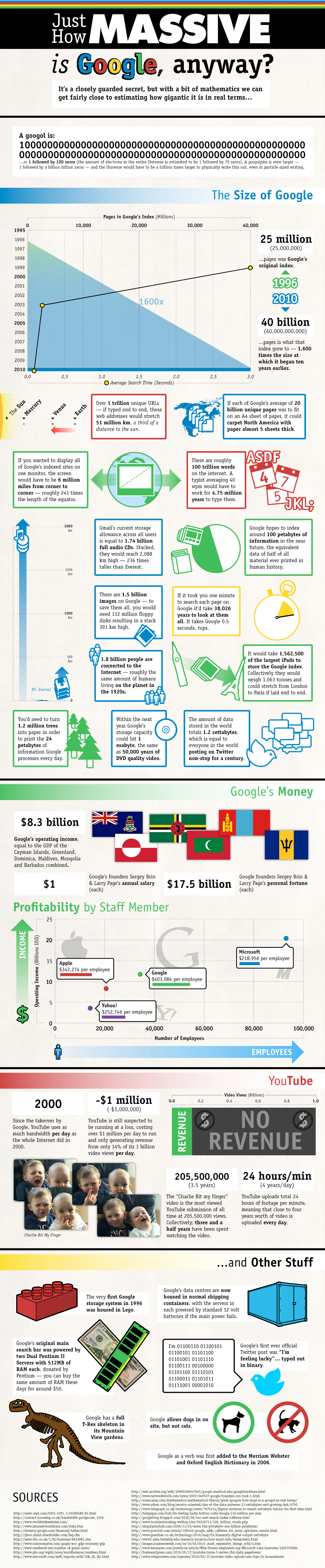
Just how massive is Google, anyway?


Google began in January 1996 as a research project by Larry Page and Sergey Brin when they were both PhD students at Stanford University in California. While conventional search engines ranked results by counting how many times the search terms appeared on the page, the two theorized about a better system that analyzed the relationships between websites. They called this new technology PageRank, where a website's relevance was determined by the number of pages, and the importance of those pages, that linked back to the original site. A small search engine called Rankdex was already exploring a similar strategy.

Page and Brin originally nicknamed their new search engine "BackRub", because the system checked backlinks to estimate the importance of a site. Eventually, they changed the name to Google, originating from a misspelling of the word "googol", the number one followed by one hundred zeros, which was meant to signify the amount of information the search engine was to handle. Originally, Google ran under the Stanford University website, with the domain google.stanford.edu. The domain google.com was registered on September 15, 1997, and the company was incorporated on September 4, 1998, at a friend's garage in Menlo Park, California.


Monday, September 27, 2010

How to Get Rid of a Headache


Sent to you by H.e.M.a.L via Google Reader:


via How to of the Day on 9/27/10

Been hitting your head against the wall too much? A common affliction, mild to moderate headaches can be brought on by a range of problems, including stress, tiredness, tension, food or alcohol, exposure to noise, a cold, etc., and on the whole, are no more serious than causing you immediate pain and interrupting your daily activities.[1] A combination of these problems interacting can also lead to a headache.

There are some things you can do to treat your headache yourself, as outlined in this article, keeping in mind that each headache is, in some ways, unique, and a treatment that works for one may not work for the next.


Steps

  1. No idea! It just feels like my head's in a clamp!
    No idea! It just feels like my head's in a clamp!
    Try to identify the type of headache that you're experiencing. Most headaches are tension or lifestyle induced and aren't harmful, even though they're painful and can prevent you from fulfilling your tasks. If you experience frequent headaches, a severe headache, a headache that won't respond to analgesics, or the headache is accompanied by other symptoms, consult your doctor or health professional for immediate investigation and a proper diagnosis. The following list of common types of headaches demonstrates the wide variety of possible causes for your headache, which is why it's so important to seek further treatment if your headache issue won't resolve:[2][3]
    • Tension headache: The most common type of headache. Many tension headaches take time to develop following physical or emotional stress but can last for days once it kicks in. This headache tends to form as a result of muscle contraction, and is commonly felt as a band behind the eyes and across the forehead, but the pain can be located anywhere in the head, including on the side or at the back. The headache may be dull, recurrent if the source is not dealt with, and can be accompanied by feeling generally unwell, especially if the sufferer also has anxiety or depression. This type of headache tends to respond well to painkillers, rest, and alleviation of the source of stress. Sometimes a tension headache is accompanied by feeling nauseous.
    • Hangover headache: The pain is real and so is what you drank the night before! Symptoms include throbbing pain, nausea, feeling generally lousy. Keep up your fluids and be patient. Use of recreational drugs can also leave headaches, as can withdrawal from prescription medications.
    • Allergy or food induced headache: With an allergy induced headache. you'll often have a runny nose and runny eyes as well as the headache, and the headache can be generalized. This type of headache tends to be seasonal and is often treated with anti-histamines; speak with your doctor about choices. MSG can induce headaches in sensitive persons; other symptoms will include facial pressure, chest pain, burning sensation on trunk, neck and shoulders and the head will throb. Nitrites and nitrates in meat can induce a moderate to severe headache. And if you eat your ice cream or drink a cold drink too quickly, you can induce a temporary "brainfreeze", or "ice cream headache" which is severe but passes quickly.
    • Migraine headache: With a migraine, the sufferer will feel throbbing pain accompanied by severe nausea and possible vomiting. There are visual problems such as seeing stars, flickering objects, and even partial loss of vision. Some migraines also cause numbness or weakness. Migraines can be caused by reactions to food, stressors, hormonal changes, an accident, and for some people, they are inherited. Migraines require special attention and you should seek advice from your doctor on what to medicate with, as well as finding methods to try and head off getting a migraine.
    • Cluster headache: This is a headache that sits around your eye area and can involve a drooping eyelid, nasal discharge and a watery eye. It tends to be more common in males, and can be ongoing. If this type of head pain is occurring, take it seriously and see your doctor for advice and treatment.
    • Headache caused by pain, problems, or tension in another part of the body: Headaches can be caused by sinus blockage, a cold, virus, or fever, coughing, physical exertion, hunger, eyestrain, strained neck or back muscles, arthritis, and by dental problems. In each case, it is essential to get your doctor's examination and advice, as you will probably need wider body treatment and not just a simple focus on the head region. If you have to wear certain items regularly, such as goggles for swimming, or pull your hair back a lot for modeling or stagework, etc., these can cause headaches in their own right – often the symptoms will be relieved by removing the item or changing your hair styling method.
    • Accident induced headache: If you involved in an accident in which your head receives a shock, bump, hit, or bang, you may develop a headache. As this can also be accompanied by concussion, skull fractures, internal bleeding, etc., you must seek immediate medical treatment. Post-traumatic headaches can arise as the result of being in an accident or traumatic situation – these can be extremely difficult to treat and may need the intervention of a specialist trained in psychology or psychiatry.
    • Aneurysm: You will experience a sudden, "thunderclap" of pain. This pain can mimic a migraine or cluster headache and can be accompanied by a stiff neck, double vision, and loss of consciousness. Get immediate, urgent medical assistance. In this case, surgery and blood pressure stabilization are the main treatments.
    • Tumor induced headache: This is rare and if you have any suspicions that this is an issue, see your doctor immediately. Some symptoms of a brain tumor might include numbness or weakness of limbs, slurred speech, disturbed vision, epileptic fits, personality changes, or poor balance. It is rare for there to be no other symptom than a headache.
    • Altitude sickness headache: If you experience altitude sickness, the pain can affect both sides of the head, or just one side. Usually impacts climbers not using oxygen. Follow the precautions for treating altitude sickness.
    • Other headaches: There are a number of other reasons for triggering a headache that are best diagnosed by a doctor; what is important to understand is that if you have any concerns, see your doctor quickly.
  2. Make it go away!
    Make it go away!
    Try different methods for alleviating your headache. Not every method suggested in the following sections will necessarily help, and it remains vital to always be alert for headache symptoms that might require a visit to the doctor. However, with trial and error, you should be able to find various methods that do alleviate your tension or other home-treatable headache and you might find that these work each time. In addition to trying different remedies, it is suggested that you:
    • Keep a record of your headaches. This will help you to identify patterns that bring about headaches, such as after a particularly stressful period at work, after communication problems, after eating certain foods, etc. and will be a way that you can start learning to head off a headache before it begins to develop. If your headaches are hormonally induced (for example, as a result of having a period), knowing when you're likely to experience hormonal fluctuations (and hence headaches) will allow you to plan accordingly to "ease up" on work and home chores at this time of the month.
    • Learn to look at all of your lifestyle factors as a whole, to identify the areas where you can reduce stressors that lead to body tension and headaches. Identifying "precipitating factors", including food, bright lights, alcohol, exercise, stress, changes in your life, sleep problems, physical exertion, etc., will ensure that you learn coping strategies that reduce the likelihood of getting a headache or other stress or tension related symptoms.

Relaxation techniques

  1. Rest is best for a normal headache
    Rest is best for a normal headache
    Rest. Rest and time out from other people, noise, and thinking about problems can go a very long way to improving a tension induced headache. Lay down in a quiet, darkened room for at last a half hour.[4] Ensure that the bed or couch is comfortable and that your head is supported in a position that doesn't increase the tension to your head. Shut your eyes and simply lie still for the time, or try to sleep.
  2. Oh that's so not helping! Concentrate!
    Oh that's so not helping! Concentrate!
    Use massage. Massage the ears and ear lobes as well as the neck. If you can, find two tennis balls or racket balls and put them in a sock. Lie on a flat surface and place the two balls just below the base of your skull on the occipital and relax. You may feel sinus pressure or minimal discomfort at first but it will go away. Stay in this position with the still point on the occipital for as long as needed. This is especially helpful for sinus headaches.
    • Have someone else massage your neck and back if possible. The simple touch of someone else who cares about you can relieve a lot of tension instantly.
    • Try massaging the top of the bridge of your nose. This can help sometimes.
  3. Try hydrotherapy. Heat and chill compresses. Apply both compresses alternately to the nape of the neck. Wring a small towel in hot water and place on the neck for two minutes. Repeat for one minute with a towel wrung in cold water. Continue doing this for up to 20 minutes.[5]
  4. Think beauty
    Think beauty
    Visualize peacefulness. Spend some time relaxing your mind. Visualize a calm scene, such as a green forest or blue ocean, and take deep breaths. Without doing anything, have the thought of allowing your neck the freedom to float, and your back the freedom to sink into something very soft. Tension in the neck and shoulders can often be the cause of headaches.
  5. Relax with someone who knows what to do!
    Relax with someone who knows what to do!
    Consider acupuncture or acupressure. These can reduce the head pain if performed by a qualified person. Ask to see licensing and check that needles are sterilized in the case of acupuncture. These techniques are good for reducing nausea.
  6. Pressuring parts of the feet for your headache!
    Pressuring parts of the feet for your headache!
    Try simple reflexology. Use the thumb and index finger of one hand to apply pressure to the fleshy area between the thumb and index finger of the other hand. Hold this for a minute or two. This doesn't seem to work for everyone, but for some people, it provides immediate relief. The relief may be temporary, or you may get rid of your headache entirely.

Medication or topical treatments for headaches

  1. Take a commercial headache preparation (analgesic) available from a pharmacy or supermarket. If you visit a pharmacy, you can describe the symptoms to the pharmacist who may be able to point you to a particular medication that might alleviate the pain. Common painkillers for headaches include aspirin, anti-inflammatories, and acetaminophen (Tylenol, Panadol, etc.). Always follow the instructions precisely as indicated on the product; not doing so can mask or worsen your condition.
    • Stop taking aspirin (a non-steroidal anti-inflammatory drug (NSAID)) if you experience indigestion or any sign of increased bruising; and do not use aspirin for children under 12.[6]
    • Stronger remedies contain codeine. This can help alleviate pain initially but it has its own side effects, including constipation and could mask more serious symptoms. If you feel as if you need to keep upping the dose, see your doctor.
  2. Use heat or cold. Depending on your preference, heat or cold can improve your headache when applied direct to the skin. You can try one or the other, or even alternate between hot and cold:[7]
    • Cold: Apply ice packs. Ice packs have been used for years to treat headaches and they still work. You usually find ice packs at your drugstore. A cold rag on your neck or forehead can also work wonders.
    • Heat: Use a moist hot pack (but not too hot) to loosen up tense muscles. Or apply a warm cloth to the forehead of back of the neck.[8]
    • A cold or warm bath before lying down might be helpful.
  3. Stimulate pain to conquer pain. Feel the top of your eye socket under the eyebrow. You will discover a small groove in your skull about the center of the top of the eye socket. In this groove is a nerve which is very sensitive to pressure. If you compress this nerve, it will be very painful. However, the pain will stimulate the pituitary to release endorphins immediately. The endorphins are the body's own natural painkillers and are more powerful than morphine. To stimulate the nerve, push hard against it for about 10 seconds. Note that this method may not work, and if you cannot tolerate doing it, or it becomes too painful, stop immediately.

Natural remedies

  1. Be informed. There are a number of natural remedies that might work to treat your headache. As with any natural remedy, always know the side effects and allergy potential of the remedy, as well as the contra-indications, such as not using when pregnant, sick, etc.
  2. Try herbal remedies. There are several herbal remedies that are considered to have value for getting rid of headaches:
    • Feverfew
      Feverfew
      Feverfew: Feverfew can be taken in capsule or tablet form, as a tea, or even eaten in a sandwich (it tastes bitter). There is mixed evidence to support the effectiveness of feverfew but it has been relied upon for centuries, so it might be worth trying.[9] There are no serious side effects to using feverfew although you might experience a sore tongue, mouth ulcers, or nausea, digestive problems and bloating. Coming off long-term use of feverfew can disrupt sleep and cause headaches.
    • Willow bark, magnesium, peppermint, and lavender supplements might help.[10] Note, however, that the scientific support for or extensive studies on the effectiveness of many of these supplements varies.[11] If you feel it works for you, and you're aware of any potential side effects, then trust your own remedies!
    • Peppermint tea
      Peppermint tea
      Tea: A cup of tea made from passionflower, rosemary, or lavender might alleviate a headache.[12] Peppermint or chamomile tea can help to relax you.
  3. Use aromatherapy. Aromatherapy preparations vary considerably but some of the more commonly used essential oils for headache treatment include lavender, sweet marjoram, and chamomile. Use for neck massaging, in a bath, or to inhale.[13]
    • For relief of aches and pains: Mix 5 drops rosemary oil, 5 drops nutmeg oil, 5 drops lavender oil in a carrier oil. Massage on the neck and upper back area.[14]
    • If you have a vaporizer, add 7 drops of lavender oil, 3 drops of peppermint oil, and breathe in the relief. Alternatively you could also try sprinkling a few drops of peppermint oil onto a tissue and inhaling deeply several times.
  4. Consider the potential for homeopathy. If you know how to use homeopathic remedies, an occasional headache might be minimized by using the following suggestions:[15]
    • Belladonna: good for headaches that arise from a reaction to noise or light.
    • Bryonia: good for headaches brought about by movement.
    • Ignacia: good for headaches brought on by acute emotional distress.
  5. Drink water. Dehydration can be a cause of some headaches. Have a glass of water to see if this helps. This can work well in combination with lying down and resting for a bit.
  6. Use food as a pick-me-up perhaps?
    Use food as a pick-me-up perhaps?
    Try food remedies. Lack of food can cause a headache, so make sure you've eaten something recently. In addition, some foods are thought to help alleviate headaches. None of the following are guaranteed but they've worked for some people, so they might just work for you:
    • Eat almonds. Almonds contain pain-relieving chemicals that might reduce your headache symptoms.[16]
    • Try cayenne pepper. Cayenne pepper might help to improve your headache. You could try consuming it (the theory being that when the cayenne pepper hits your stomach, endorphins are released), but some research suggests that only topical application works effectively.[17] It is probably best to get your doctor's advice if you're planning to apply this topically!
    • Apply a compress with vinegar (preferably home-made, apple vinegar) to your head.
    • Drink a cup of caffeine. Caffeine constricts the blood vessels, which can lessen head pain. But too much caffeine may trigger migraines in some people so instead of coffee, you might like to try tea. If taken in conjunction with a painkiller, caffeine can also speed up the medicine's effect, and as a result some painkillers include caffeine. Alternately, you can drink cola. Note that if you're a heavy caffeine or soda drinker, you may experience headaches as part of caffeine withdrawal. A jolt of caffeine will usually help, but in the long run, it's best to break your addiction and the headaches will disappear.
    • Take a lime, cut it in half, and rub it on your forehead. The throbbing will go away.

Exercise techniques

  1. You might feel tied up but stretching can help!
    You might feel tied up but stretching can help!
    Stretch. If you have a tension headache, stretching your neck and back muscles might improve your headache by acting on the tense parts of your body.
  2. Do some yoga. Yoga aimed at reducing tension can remove or minimize headaches. Simple neck rolling or relaxation yoga exercises are best.
  3. Walk away that headache
    Walk away that headache
    Take a brisk walk in the fresh air. This can be especially effective if you've been sitting hunched up for a while and you have a lot of challenging thoughts circulating in your head. The exercise will get the blood moving, the new scenery will refresh your outlook, and the fresh air will awaken you. By the time you return home, you might find that you're feeling much better.
  4. Try laughing the headache out!
    Try laughing the headache out!
    Try laughing or smiling. These can work wonders if it's just a minor headache. Smiling and laughing release endorphins within the brain, working on a positive feedback loop - the more you smile and laugh, the more "feel-good" chemicals the brain releases, and the more of these chemicals it releases, the more you smile and laugh! Endorphins will help to relieve the pain.

Lifestyle fixes

  1. Don't use a computer while you have a headache!
    Don't use a computer while you have a headache!
    Check your workstation at home and work. The way that you're sitting at the desk and using a computer might be contributing to your headache. Be sure that everything is at the right height and distance for your size.
    • Take regular breaks from all desk work and computer use. Exercise your eyes by looking at different distances for a few minutes every hour and do some basic body stretches.
  2. Visit your dietician for advice
    Visit your dietician for advice
    Implement dietary changes. Although this won't alleviate your headache straight away, making dietary changes in the longer term can potentially remove a source of headaches for you in the future. If you don't know where to begin, see your doctor, a dietician/nutritionist, or a naturopath.
    • Find out whether you have any particular food allergies and eliminate those foods from your diet.
    • Reduce your intake of caffeine. Caffeine can induce headaches. Ironically, withdrawal from caffeine will probably cause a temporary headache but once you're through the withdrawal period, you'll notice a positive difference.
    • You might like to consider avoiding of minimizing potential headache triggering foods, especially those containing MSG, nitrites and nitrates (cured meats), tyramines (aged cheese, wine, beer, and processed meats), sulphites (dried fruits, condiments, and wine), and salicylates (tea, vinegar, and some fruit).
  3. See the physio
    See the physio
    Treat musculoskeletal problems. If your back or neck are misaligned, or you're suffering from poor posture and muscle tension, it's important to fix this source of pain. While you can try to improve your musculoskeletal problems through exercise such as stretching, yoga, pilates, etc., it is usually important to see a specialist such as a physiotherapist, chiropractor, or osteopath to assess and treat your condition.[18]
  4. See your dentist
    See your dentist
    See your range of health professionals. If you're experiencing problems in other parts of your head, it can be a good idea to get help that might alleviate the headache. For example:
    • See your dentist: If you have jaw misalignment, tooth decay, abscesses, or post-extraction infection, these can be a source of headaches.
    • See your optician: If you need glasses but it has gone undiagnosed, your eyestrain could be causing unnecessary headaches.
    • See your ear, nose and throat specialist: If you have untreated infections, perforations, or other problems with your ears, nose, and throat, these could cause headaches.
  5. Remain calm
    Remain calm
    Calm down. If you're angry, irritable, frustrated, etc., you may be building up daily muscle tension to a point where it has become unmanageable and causes headaches. Seek professional counseling or psychological help for mapping out some fruitful ways to manage your emotions if they're dominating your approach to life every day.
    • If you clench your jaw or grit your teeth, make an effort to relax your face. Try yawning to reduce facial tension.
    • Practice relaxation exercises before stress-producing events like exams, getting married, taking a driver's test, etc.

Video

Tips

  • Having pre-made meals in the freezer can be a huge relief if you have regular tension headaches. This removes a source of stress if you're expected to make dinner, as all you need to do is heat up the meal while you're resting. This alone can be enough to draw off an evening headache after a day's work, as you can take the time to rest peacefully instead of trying to prepare a meal.
  • Don't be afraid to withdraw from other people to rest. Remaining around people and trying to stay perky when you've got a headache can worsen it. You'll be better company for a rest.
  • Rub tiger balm on your temples. The menthol might be able to distract your senses and help alleviate the pain.
  • If it's a sinus headache, try eating a spoonful of honey made in your local area every day. While it won't help immediately, it might help to build up your immunity from local pollens.
  • Avoid elevating your head when resting for a headache – keep it as level with your body as possible.
  • If you get migraines frequently, as well as working out a plan with your doctor, try avoiding trigger foods such as cheese or chocolate. Eating and sleeping regularly is also important to ward off migraines.[19]
  • Visit the bathroom. If you haven't already done so, sometimes a trip to the bathroom can alleviate a headache!
  • Something that triggers one headache may not trigger others. It depends on your constitution, exposure levels, and sensitivity. Even doctors don't like coming up with "one-size-fits-all" headache lists!
  • Relax your tongue. Having your tongue on the roof of your mouth can cause headaches. Keep your tongue off the roof of your mouth, and the pain from your headache should decrease.

Warnings

  • See a doctor immediately if you experience any of the following symptoms or signs: a headache that feels worse than any you've ever experienced before, headaches that change in their pattern (for example they're usually mild and suddenly they're severe), the headache feels weird and unfamiliar, the headache is sudden and abrupt, it worsens over days and doesn't stop, the headache comes with neck pain and a fever (it might be meningitis), or you experience epileptic fits, convulsions, vomiting, inability to tolerate bright light, rashes, weakness in any part of your body, or your personality changes.[20]
  • Some medications can cause headaches, such as the birth control pill. Seek advice from your doctor if you're taking a medication regularly and experiencing headaches. The headaches might be a side effect, or an indication of something that needs attention.
  • Be careful using over-the-counter drugs. Overdosing with Tylenol (acetaminophen) is toxic to the liver. No more than 2 in a six hour period! Taking Tylenol with alcohol greatly increases the danger to the liver. Always read the directions before taking any painkillers, and take the smallest effective dose. Avoid taking NSAIDs if you have an ulcer, gastrointestinal problems, indigestion, or asthma.[21]
  • Be careful if pinching nerves to try and stop a headache. Behind the sternocleidomastoid is the carotid artery and vagus nerve. Pinching these off can cause faintness, or possibly even brain damage by disturbing blood flow to the brain. If you feel faint, dizzy, or nauseated while working on that muscle, stop immediately and lie down for several minutes. If symptoms persist, get immediate medical attention.
  • Take head injuries seriously. It's generally a good idea to seek medical advice for any head injury, even if you don't experience concussion, obvious injury, or pain.
  • You can find a ton of headache remedies on the internet or by asking people you know. Many of these are helpful for at least some people, and if they're safe, there's no reason not to try them if other steps don't work. Use common sense when considering any "home remedy." If it seems like it could cause more harm than good, don't use it without consulting your doctor first. If a treatment makes your headache worse, or if you experience other symptoms, stop the treatment and contact your doctor.

Things You'll Need

  • Exercise area
  • Walking gear (shoes, clothing, etc.) that is comfortable and fits well
  • Analgesics or herbal remedies, as per instructions
  • Quiet, dark room for rest

Related wikiHows

Sources and Citations

Article Tools


Things you can do from here:


Gayatri Mantra and Scientific Implication

Gayatri Mantra and Scientific Implication

 
GAYATRI MANTRA AND
MANTRA'S SCIENTIFIC INTERPRETATION
 
http://keralites.net/ 
 

 Gayatri mantra has been bestowed the greatest importance in Vedic dharma. This mantra has also been termed as Savitri and Ved-Mata, the mother of the Vedas.


Om bhur bhuvah swah
Tat savitur varenyam
Bhargo devasya dheemahi
Dhiyo yo nah prachodayat


The literal meaning of the mantra is:

O God! You are Omnipresent, Omnipotent and Almighty, You are all Light. You are all Knowledge and Bliss. You are Destroyer of fear, You are Creator of this Universe, You are the Greatest of all. We bow and meditate upon Your light. You guide our intellect in the right direction.


The mantra, however, has a great scientific importance too, which somehow got lost in the literary tradition. The modern astrophysics and astronomy tell us that our Galaxy called Milky Way or Akash-Ganga contains approximately 100,000 million of stars. Each star is like our sun having its own planet system. We know that the moon moves round the earth and the earth moves round the sun along with the moon. All planets round the sun. Each of the above bodies revolves round at its own axis as well. Our sun along with  its family takes one round of the galactic center in 22.5 crore years. All galaxies including ours are moving away at a terrific velocity of 20,000 miles per second.

 
http://keralites.net/http://keralites.net/ 
http://keralites.net/


The alternative scientific meaning of the mantra
Line by Line


Line 1:

 OM BHUR BHUVAH SWAH:

Bhur the earth, bhuvah the planets (solar family), swah the Galaxy. We observe that when an ordinary fan with a speed of 900 RPM (rotations Per minute) moves, it makes noise. Then, one can imagine, what great noise would be created when the galaxies move with a speed of 20,000 miles per second. This is what this portion of the mantra explains that the sound produced due to the fast-moving earth, planets and galaxies is Om. The sound was heard during meditation by Rishi Vishvamitra, who mentioned it to other colleagues. All of them, then unanimously decided to call this sound Om the name of God, because this sound is available in all the three periods of time, hence it is set (permanent). Therefore, it was the first ever revolutionary idea to identify formless God with a specific title (form) called upadhi. Until that time, everybody recognized God as formless and nobody was prepared to accept this new idea. In the Gita also, it is said, "Omiti ekaksharam brahma", meaning that the name of the Supreme is Om , which contains only one syllable (8/12). This sound Om heard during samadhi was called by all the seers nada-brahma a very great noise), but not a noise that is normally heard beyond a specific amplitude and limits of decibels suited to human hearing. Hence the rishis called this sound Udgith musical sound of the above, i.e., heaven. They also noticed that the infinite mass of galaxies moving with a velocity of 20,000 miles/second was generating a kinetic energy = 1/2 MV2 and this was balancing the total energy consumption of the cosmos. Hence they named it Pranavah, which means the body (vapu) or store house of energy (prana).http://keralites.net/

http://keralites.net/


Line 2:   TAT SAVITUR VARENYAM:

Tat that (God), savitur the sun (star), varenyam worthy of bowing or respect. Once the form of a person along with the name is known to us, we may locate the specific person.Hence the two titles (upadhi) provide the solid ground to identify the formless God, Vishvamitra suggested. He told us that we could know (realize) the unknowable formless God through the known factors, viz., sound Om and light of suns (stars). A mathematician can solve an equation x2+y2=4; if x=2; then y can be known and so on. An engineer can measure the width of a river even by standing at the riverbank just by drawing a triangle. So was the scientific method suggested by Vishvamitra in the mantra in the next portion as under:-


Line 3:
BHARGO DEVASYA DHEEMAHI:

Bhargo the light, devasya of the deity, dheemahi we should meditate. The rishi instructs us to meditate upon the available form (light of suns) to discover the formless Creator (God). Also he wants us to do japa of the word Om (this is understood in the Mantra). This is how the sage wants us to proceed, but there is a great problem to realize it, as the human mind is so shaky and restless that without the grace of the Supreme (Brahma) it cannot be controlled. Hence Vishvamitra suggests the way to pray Him as under:


Line 4:

DHIYO YO NAH PRACHODAYAT

Dhiyo (intellect), yo (who), nah (we all), prachodayat (guide to right Direction). O God! Deploy our intellect on the right path. Full scientific interpretation of the Mantra: The earth (bhur), the planets (bhuvah), and the galaxies (swah) are moving at a very great velocity, the sound produced is Om , (the name of formless God.) That God (tat), who manifests Himself in the form of light of suns (savitur) is worthy of bowing/respect (varenyam). We all, therefore, should meditate (dheemahi) upon the light (bhargo) of that deity (devasya) and also do chanting of Om. May He (yo) guide in right direction (prachodayat) our(nah) intellect dhiyo.


The important points hinted in the mantra are


1) The total kinetic energy generated by the movement of galaxies acts as an umbrella and balances the total energy consumption of the cosmos. Hence it was named as the Pranavah
(body of energy). This is equal to 1/2 mv2
(Mass of galaxies x square of velocity.)


2) Realizing the great importance of the syllable OM , the other later date religions adopted this word 
with a slight change in accent, 
viz., Amen and Ameen.